How To Find Your Property On FEMA’s Flood Insurance Rate Maps

What are FEMA flood maps?
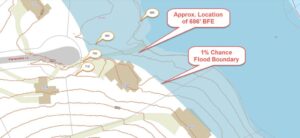
FEMA’s Flood Insurance Rate Maps (FIRMs) or just Flood Maps are provided after a flood risk assessment has been completed or updated for a community.  This study is known as a Flood Insurance Study.  The FIRM gives you the Base Flood Elevations (BFEs) and insurance risk zones in addition to floodplain boundaries.  The FIRM may also show a delineation of the regulatory floodway.

Once the “insurance risk zone”  (commonly referred to as the flood zone) is determined, actuarial rates, based on these risk zones, are then applied for newly constructed, substantially approved, and substantially damaged buildings.  FEMA uses these rates to determine the insurance rate you will pay for flood insurance

FEMA’s Digital Flood Maps

FEMA discontinued the production and distribution of paper flood maps in 2009 as part of its Digital Vision Initiative. This affected all the Flood Maps, boundary information, and study reports. However, clients can still view the products for free through their website or buy them in digital format.

To view these flood maps online, go to FEMA’s Map Service Center and key in your address (hi-lited area shown here) search for your home.  This will prompt you to then select the map that covers your area.  The Flood Maps are somewhat cumbersome to use online. It is best to go through the tutorial on the bottom right of the address search page for an easier and more effective use of the GIS map.

author avatar
Surveyor

More Posts

Drone surveying in progress over an active construction site to help reduce project delays
land surveying
Surveyor

How Drone Surveying Cuts Construction Timelines Fast

If you ask most builders in Troy what slows down a project, they will not say lumber or concrete. They will wait. Waiting on plans. Waiting on approvals. Waiting on site data. That is exactly why drone surveying is getting so much attention right now. Across Alabama, developers and property

Read More »
3D digital elevation model displayed on a monitor showing terrain analysis used for lidar mapping projects
land surveying
Surveyor

LiDAR Mapping: How the USGS Update Changes Projects

Big news recently changed how land data works across the country. The U.S. Geological Survey (USGS) finished its nationwide 3D Elevation Program, called 3DEP. In simple terms, the federal government now has updated elevation data for the entire United States. That includes Alabama. At first, this sounds like great news

Read More »
A land survey company using GPS equipment to locate a boundary marker before setting property lines
land surveying
Surveyor

Why a Land Survey Company Must Check PLSS Corners First

Buying land or owning property feels simple at first. You look at your yard, see the fence, and assume that’s the line. Maybe the neighbor points to a tree and says, “That’s the corner.” It sounds clear enough. However, property lines don’t begin with fences, trees, or guesses. They begin

Read More »
Large road expansion project reshaping land as nearby property owners search for surveyors near me
land surveyor
Surveyor

Why Growth Is Driving “Surveyors Near Me” Searches

Drive around Mobile today and you’ll notice something different. New road signs pop up along familiar routes. Fresh grading marks appear near wooded lots. Subdivision entrances rise where open land once sat. Meanwhile, crews move equipment near highways, ports, and growing commercial corridors. Mobile is building. And when a city

Read More »
Land surveyor measuring a property for a flood elevation certificate
flood damage
Surveyor

Flood Elevation Certificate: What Lenders Really Require

Buying or refinancing a home should feel exciting. However, many people hit a sudden wall when their lender asks for a flood elevation certificate halfway through the loan process. The request often shows up without warning, and naturally, it creates stress. Most borrowers assume a flood map check should be

Read More »
Surveyor taking precise field measurements on an active construction job site
land surveyor
Surveyor

How a Surveyor Keeps RTK Corrections Stable on Site

Many people assume GPS measurements always work the same way everywhere. You turn on the equipment, wait a few seconds, and get perfect coordinates. However, that’s not how high-accuracy field positioning really works. On active job sites, conditions change fast. Signals drop. Connections fail. Equipment overheats. Because of that, accuracy

Read More »