When buying or building on a property, you will likely need a survey. But which kind? The ALTA survey vs. boundary survey question confuses many buyers, investors, and builders. Both deal with property lines, but they are not the same thing. Picking the wrong one can delay your closing or fail your lender’s requirements. This guide explains the difference in plain terms so you can choose the right survey for your project.
What Is an ALTA Survey?
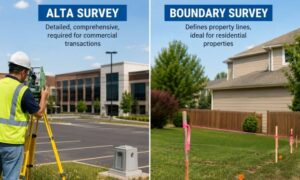
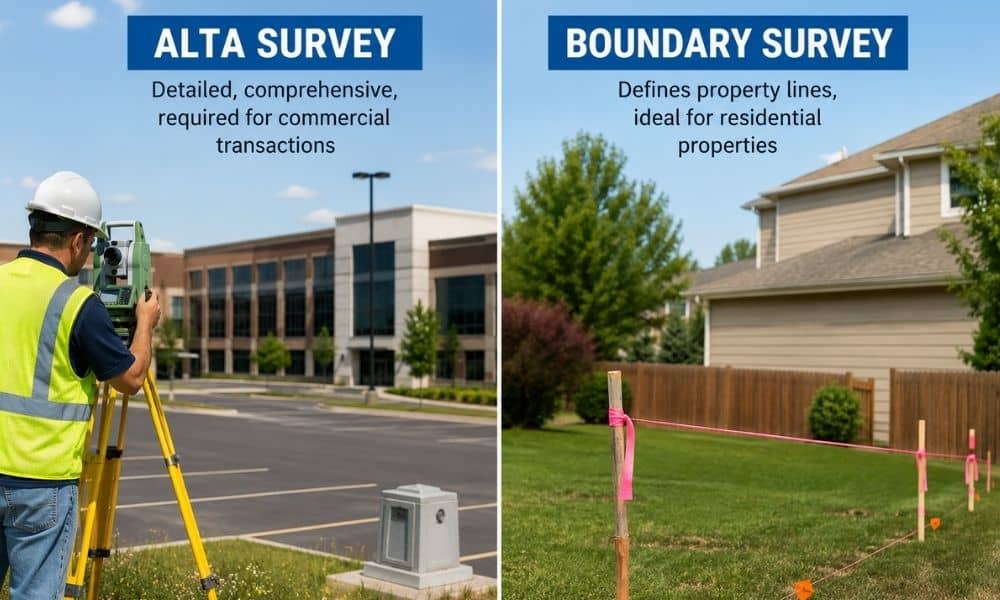
An ALTA survey is a detailed land title survey that follows the joint standards of the American Land Title Association (ALTA) and the National Society of Professional Surveyors (NSPS). It is the most complete survey type available and is usually required for commercial real estate deals and title insurance policies.
An ALTA survey follows the 2026 ALTA/NSPS Minimum Standard Detail Requirements. These are national rules that every ALTA survey must follow, no matter what state you are in.
An ALTA survey covers:
- Boundary lines with exact measurements
- Easements and rights-of-way from public records
- Encroachments, which are structures that cross into another property
- Locations of utilities, roads, and access points
- Flood zone classification from current FEMA maps
- All buildings, fences, parking lots, and structures on the land
- Zoning classification and setback rules
According to the American Land Title Association, title insurance covers more than $2.5 trillion in real estate deals every year in the U.S. An ALTA survey is required before the strongest title insurance policies can be issued.
What Is a Boundary Survey?
A boundary survey finds and marks the legal corners and edges of a property based on deeds, plat maps, and public records. It shows where your land ends and your neighbor’s begins. It is the most common survey type for homeowners and residential buyers.
A boundary survey, also called a lot survey or property line survey, confirms the legal edges of your parcel. A licensed surveyor researches old records and then places physical corner markers in the field.
A boundary survey includes:
- Legal corner markers such as iron pins or concrete monuments
- Boundary line distances and directions
- Any encroachments between neighboring properties
- A map or plat showing the results
A boundary survey does NOT include:
- Easement research from title documents
- Flood zone data
- Utility locations
- Zoning or setback information
- Structure or improvement locations, unless you request them separately
This makes boundary surveys faster and more affordable. But they are less detailed than ALTA surveys.
Key Differences at a Glance
| Feature | ALTA Survey | Boundary Survey |
| Governing standard | ALTA/NSPS 2026 | State board standards |
| Required for commercial loans | Yes | Rarely |
| Required for title insurance | Yes (commercial) | No |
| Shows easements from title work | Yes | No |
| Shows structures and improvements | Yes | Not always |
| Includes flood zone data | Yes | No |
| Best for residential use | Rarely needed | Yes |
| Typical turnaround time | 2 to 4 weeks | 1 to 2 weeks |
| Typical cost in Alabama | $2,500 to $6,000+ | $400 to $1,500 |
According to the National Society of Professional Surveyors, ALTA surveys make up about 38% of all commercial property survey orders placed by title companies and lenders in the U.S.
When Do You Need an ALTA Survey?
You need an ALTA survey when a lender or title company requires it to close a commercial real estate deal. It is also the right choice for properties with a complex title history, multiple easements, or when you are buying land for development or investment.
Common situations that require an ALTA survey:
- Buying a commercial building, strip mall, or office property
- Getting a commercial construction loan
- Purchasing title insurance for a non-residential transaction
- Completing a 1031 exchange or multi-property acquisition
- Conducting due diligence during a business purchase that includes real estate
When Do You Need a Boundary Survey?
A boundary survey is the right choice for homeowners who need to confirm property lines, settle a neighbor dispute, pull a permit, or prepare for a residential sale. It is faster, more affordable, and fits most individual property owner needs.
Common situations that call for a boundary survey:
- Before building a fence to avoid crossing into a neighbor’s yard
- Resolving a dispute about where your property ends
- Pulling permits for a pool, deck, or home addition
- Buying or inheriting rural land with vague deed descriptions
- After flooding or erosion that may have shifted visible markers
The American Society of Civil Engineers estimates that about 12% of all residential real estate closings are delayed or complicated by boundary issues that an earlier survey could have caught.
Can a Boundary Survey Replace an ALTA Survey?
No, not for commercial transactions. Lenders and title companies require the specific format and content of an ALTA/NSPS survey. A basic boundary survey cannot meet those requirements. For residential deals, a boundary survey is usually enough and much more cost-effective.
A boundary survey is always completed as part of an ALTA survey. The surveyor establishes the boundary first, then adds all the extra ALTA/NSPS required elements. But a boundary survey alone does not satisfy ALTA standards for commercial use.
Cost Comparison
| Survey Type | Residential | Small Commercial | Large Commercial |
| Boundary Survey | $400 to $800 | $800 to $1,500 | $1,500 to $3,000 |
| ALTA Survey | Not typical | $2,500 to $4,000 | $4,000 to $8,000+ |
A 2024 CoreLogic report found that the average commercial real estate deal in the southeastern U.S. takes 47 days from contract to close. Survey delays are one of the top five reasons closings get pushed back. Ordering your ALTA survey early in the due diligence period saves time and reduces stress.
How to Choose the Right Survey
Choose an ALTA survey if:
- You are buying or financing a commercial property
- Your lender or title company has specifically asked for one
- The property has a complex history of easements or prior ownership
- You need extended title insurance coverage
Choose a boundary survey if:
- You are a homeowner confirming lot lines
- You are building a fence, addition, or accessory structure
- You are settling a property line dispute with a neighbor
- No lender or title company is requiring an ALTA
Frequently Asked Questions
Does a boundary survey satisfy lender requirements?
No. Most commercial lenders require a full ALTA/NSPS Land Title Survey. A boundary survey does not include the easement analysis, flood zone data, or certifications that lenders and title companies need.
How long is an ALTA survey valid?
Most lenders and title companies treat an ALTA survey as current for 6 months from the certification date. After that, a new survey or recertification may be needed if conditions have changed.
Who pays for an ALTA survey, the buyer or the seller?
This is usually negotiable. In commercial deals, the buyer typically orders and pays for the ALTA survey as part of due diligence. In some cases, the cost is shared or credited at closing.
Is an ALTA survey ever needed for a home purchase?
Rarely. ALTA surveys are built for commercial transactions. For most home purchases, a boundary survey or mortgage location survey is enough. A buyer purchasing a high-value or complex residential property may choose to order one for extra protection.