A land surveyor verifies a property line encroachment by checking legal records, locating boundary points on-site, and measuring structures against those lines. In Oxford, this process helps property owners avoid permit delays, design errors, and expensive fixes before building or buying.
What is a property line encroachment?
A property line encroachment happens when a structure crosses into land that does not belong to you. This can include a driveway, a shed, or part of a building that extends past the legal boundary.
Even a small overlap counts. A few inches can affect permits, property value, and construction plans. Many owners assume something is fine because it looks close but not over. That assumption often leads to problems later.
Why can’t you trust fences or online maps?
Fences, tree lines, and online maps look convincing. They are often wrong.
Fences shift over time, and some get placed without measurement. Online maps rely on rough data, so lines can move depending on the source. What you see on a screen is not a legal boundary.
That gap between appearance and reality leads to bad decisions. A project may move forward based on a guess, then stop once real measurements come in.
Surveyors rely on recorded data and field measurements, not visual guesses.
What records does a land surveyor check first?
Before stepping on-site, a surveyor gathers records that define the property.
They review:
- Deed descriptions
- Recorded plats
- Prior surveys, if available
- Easements and right-of-way records
Each document adds detail. Together, they show where the boundary should be.
Without this step, field work has no reference. Measurements would not hold up for permits or planning.
How does a land surveyor locate property lines on-site?
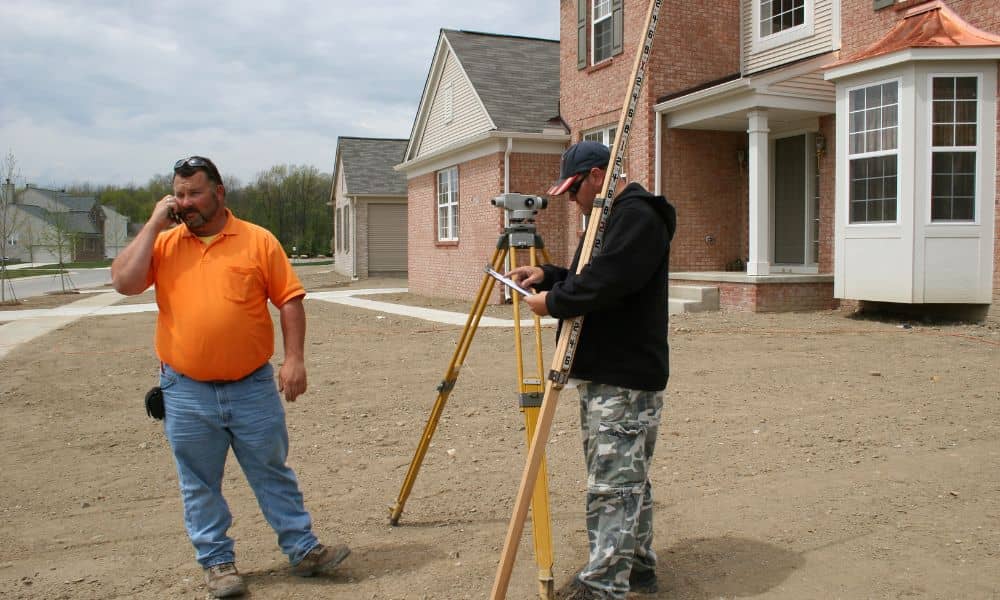
Once on-site, the surveyor works to confirm boundary points.
Sometimes markers are still in place. These may be metal pins or monuments set during a past survey. In other cases, they are gone due to construction, grading, or weather.
When markers are missing, the surveyor uses nearby reference points and recorded data to re-establish them. Even a small error can change the final boundary location.
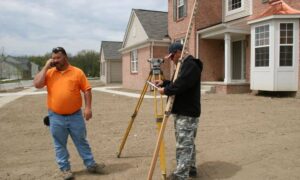
Surveyors use GPS equipment and total stations to measure position and distance. These tools can reach accuracy within a few hundredths of a foot, which allows surveyors to detect even small encroachments.
How does a surveyor measure structures against property lines?
After confirming the boundary, the surveyor measures everything that could affect the result.
This includes:
- Building corners
- Driveway edges
- Concrete pads
- Utility placements
Each point gets measured and compared to the legal boundary.
If something crosses the line, the surveyor calculates how far it extends. This is a precise measurement shown on the final drawing.
Even small overlaps matter. A few inches can delay permits or require design changes.
What is the difference between an encroachment and a setback issue?
An encroachment happens when a structure crosses the property line.
A setback issue happens when a structure stays inside the boundary but sits too close to it.
Oxford has local rules that control how close structures can be to property lines. These distances often range from 5 to 25 feet depending on zoning.
A structure can stay inside your property and still break those rules. That creates a different type of problem.
A survey helps identify both, so you know what needs to change before moving forward.
What does a survey showing an encroachment include?
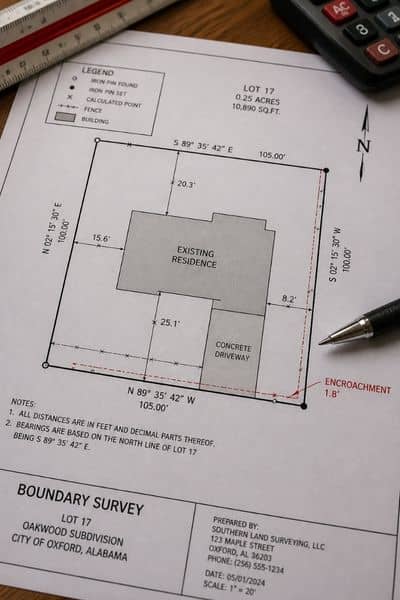
An encroachment survey shows where structures sit in relation to legal property lines and identifies any overlap.
After field work is complete, the surveyor prepares a drawing.
This document shows:
- Legal boundary lines
- Structure locations
- Measured distances to the boundary
- Any overlap, labeled clearly
This drawing gives clear proof. Builders use it for planning, and permit offices use it for review. Buyers and sellers also rely on it during transactions.
Without this document, decisions rely on guesswork.
When are encroachments usually discovered?
Encroachments tend to show up at key points in a project.
Most people find them:
- Before buying property
- During site planning
- While designing a project
- Before submitting permits
These are the stages where accuracy matters most. A missed issue at this point can delay a project by one to three weeks in many cases.
Catching the problem early keeps everything moving.
What should you do after an encroachment is confirmed?
Once the survey shows the situation, the next step depends on your plans.
Some property owners adjust their layout. Moving a driveway or shifting a structure may solve the issue before construction begins.
Others use the survey to guide design changes. Knowing the exact boundary allows for better spacing and placement.
The goal is simple. Fix the issue before it grows into a larger problem.
When should you call a land surveyor?
Timing matters more than most people think.
You should contact a surveyor:
- Before buying land or a home
- Before building or adding structures
- When planning a site layout
- When something looks off but you are not sure
Waiting creates risk. By the time the issue shows up, changes cost more and take longer.
Working with a land surveyor early gives you clear answers before plans are locked in.
Why does verification save time and money?
Construction depends on accuracy. A small mistake at the start can turn into delays, redesign, or extra cost.
A verified survey helps:
- Avoid permit issues
- Keep construction on schedule
- Prevent layout errors
- Support better planning
Property lines do not move. Your plans either match them or they do not.
A survey gives you that answer before it becomes a problem.